Beginner Wakeboard Tricks: Your First 12 Moves in Order
The best beginner wakeboard tricks are the ones that build on each other: a solid start, confident carving, riding switch, then a surface 180 and an ollie before you hit your first small kicker or box.
This guide explains each step: what it is, the key tips, the most common mistake, and which Thai parks have the right setup to practise it. Feature lists come from park information as of October 2026, and obstacles rotate, so confirm with the park what is in the water on your day. If you have never ridden before, start with our beginner guide.
The progression at a glance
| Step | Trick | You're ready when |
|---|---|---|
| 1 | Deep-water or dock start | You get up 4 out of 5 times |
| 2 | Riding regular or goofy | You can ride a full lap or line without falling |
| 3 | Carving | You can cut left and right on purpose |
| 4 | Switch riding | You can ride with your other foot forward |
| 5 | Turning at towers / line ends | You keep tension through the corners |
| 6 | Surface 180 | You spin to switch and back on flat water |
| 7 | Ollie | You leave the water from flat |
| 8 | Small kicker straight air | You land flat and ride away |
| 9 | Grab | You touch the board in the air |
| 10 | Fun box | You ride across the top in balance |
| 11 | 50-50 | You slide a box straight |
| 12 | What's next | Pick your direction |
New terms are explained in the wakeboard glossary.
1. Deep-water or dock start
What it is: getting up from sitting in the water (deep-water start) or from a seated position on the start dock, which is how most cable parks launch riders.
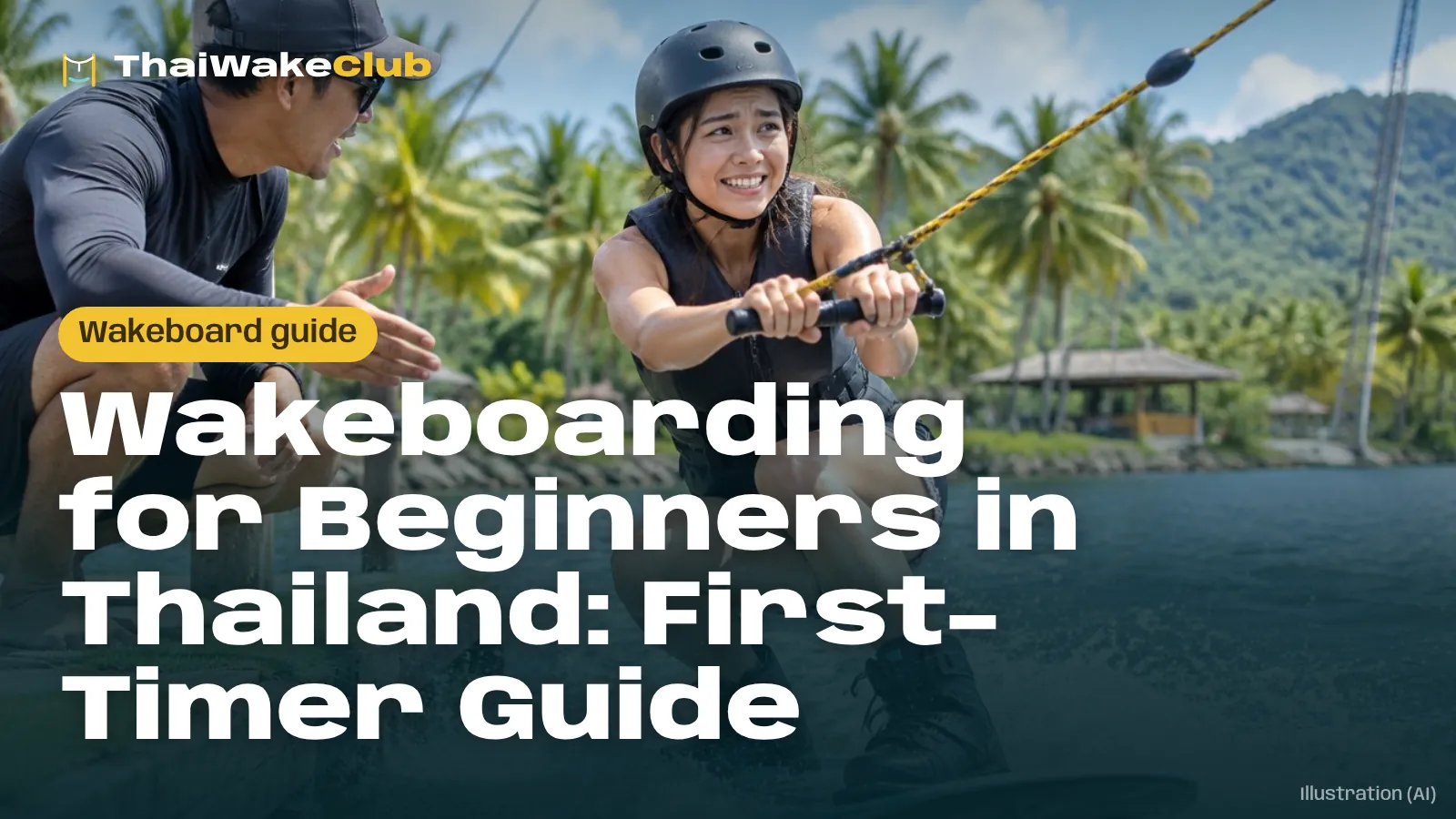
Key tips: keep your knees bent tight to your chest, arms straight, and let the cable pull you up. Stand up slowly and only once the board is planing.
Common mistake: pulling the handle towards you or standing up too early, which sends you over the front of the board.
Where to practise: a 2-tower System 2.0 line, where the operator controls the speed and a coach stands close. Good options are the training cables at Thai Wake Park Lumlukka and ESC Rangsit, the Low Speed Session at Thai Wake Park Pattaya, WakeGarden, and the shallow beginner pool at Neverdry.
2. Riding regular or goofy
What it is: riding with your left foot forward (regular) or right foot forward (goofy). Use whichever feels natural.
Key tips: hold the handle low, near your front hip. Keep your weight slightly on the back foot, and look where you want to go, not at the board.
Common mistake: standing straight-legged. Soft knees absorb chop and keep you balanced.
Where to practise: any beginner line. Varapa's green line and the short beginner run at Kite Cable Thailand are designed for it.
3. Carving
What it is: turning across the water by putting pressure on your heel edge or toe edge.
Key tips: turn by moving your weight and your knees, not your arms. On the toe side, keep both hands on the handle and push your hips forward.
Common mistake: carving too hard against the pull. The line goes slack, then snaps tight and pulls you over.
Where to practise: full-size cables give you long straights. Taco Lake is good value for long sessions (400 THB until 18:00 as of October 2026).
4. Switch riding
What it is: riding with your other foot forward. Almost every spin finishes switch.
Key tips: start with gentle carves, then a full straight.
Common mistake: skipping it. Riders who cannot ride switch get stuck at the surface 180 stage.
Where to practise: anywhere with long, quiet straights, such as the full-size cables at Lumlukka, ESC, Taco Lake or Phuket Wake Park.
5. Turning at towers and line ends
What it is: on a full-size cable, keeping your line through the corner when the cable changes direction at a tower. On a 2-tower line, slowing down and turning to ride back when the cable reverses.
Key tips: on a full-size loop, carve slightly outside the corner just before the tower so the line stays tight, then let it pull you round. On a 2.0 line, follow your coach's call: usually you sink gently and turn the board around as the cable stops.
Common mistake: cutting inside the corner. The line goes slack and snaps you forward when it tightens.
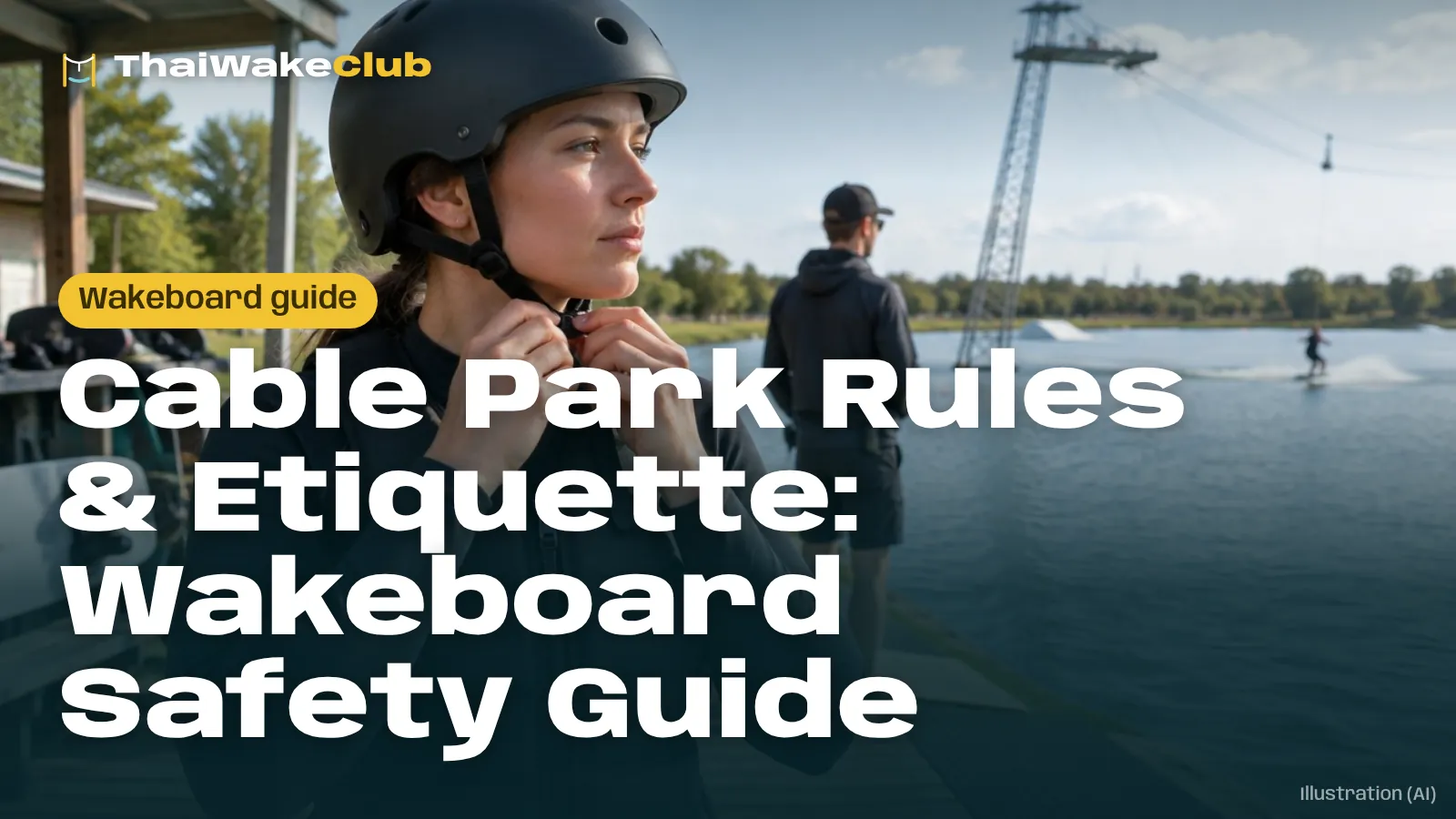
Where to practise: this is mainly a full-size skill. Practise it at Lumlukka, ESC, Taco Lake, Pattaya or Phuket Wake Park. Read our safety and etiquette guide for right-of-way rules on a busy cable.
6. Surface 180
What it is: spinning the board 180 degrees on the water's surface, from regular to switch, without leaving the water.
Key tips: flatten the board first, then turn your shoulders and hips together while you keep the handle close to your hip. The board follows your upper body.
Common mistake: catching an edge mid-spin. Keep the board flat, not on an edge.
Where to practise: flat water on any cable. 2-tower parks with speed control (WakeGarden, Neverdry, Lakehouse CNX) let your coach slow the line down for this.
7. Ollie
What it is: a jump from flat water, using the board's flex to lift off.
Key tips: shift your weight to the back foot to load the tail, then spring up and pull your knees up. Land with soft knees.
Common mistake: jumping with locked legs.
Where to practise: anywhere; learn it before step 8.
8. Small kicker straight air
What it is: riding up a small ramp (kicker) and landing straight, with no spin.
Key tips: approach in a straight line at a steady speed, stay centred with your knees bent, and keep the handle low. Let the kicker lift you. Do not pop hard off the top.
Common mistake: leaning back on the ramp, which leads to landing on the tail and slapping backwards.
Where to practise: pick the smallest kicker you can find. Varapa's green line has a small kicker. WakeGarden has one kicker, Neverdry has one in its features pool, Kite Cable has kickers on its longer run, and Taco Lake has four on the main cable. Wear a helmet from here on.
9. Grab
What it is: touching your board in the air off a kicker or ollie. The easiest is the indy (back hand on the toe edge between the feet) or the mute (front hand on the toe edge).
Key tips: bring the board up to your hand by pulling your knees up; do not reach down for it.
Common mistake: bending at the waist.
Where to practise: the same kickers as step 8.
10. First box or fun box
What it is: riding up and over a wide, flat-topped box.
Key tips: ride on a flat base, not an edge. Approach straight, at a moderate speed, with your eyes on the end of the box.
Common mistake: being on an edge at the start of the box, which slides you off sideways.
Where to practise: Lumlukka and Pattaya list fun boxes, ESC lists mini boxes and a funbox set, Taco Lake has a box, Varapa's red line has a mini box/upbox, and Phuket Wake Park has a double-base funbox. Zanook lists an A-frame funbox and Little Plant a box, but both are unconfirmed for 2026, so confirm with the park.
11. 50-50
What it is: sliding straight along a box or rail with the board parallel to it.
Key tips: stay centred and balanced, with the handle at your waist and your shoulders level. Ride off the end flat and absorb the drop with your knees.
Common mistake: looking down at your feet.
Where to practise: start on a wide box before moving to rails. The ESC and Lumlukka main cables have the widest selection.
12. What's next
Once you can ride a 50-50 confidently, choose your direction:
- Rails and boxes: board slides, nose and tail presses, then 180s on and off.
- Air: frontside and backside 180s off the kicker, then back roll lessons with a coach.
Riding the right size board helps. See our wakeboard size guide, and consider a private coaching hour (795 THB at Lumlukka and ESC as of October 2026, plus the ride ticket).
FAQ
What is the easiest wakeboard trick?
The surface 180 is usually the first "trick" riders learn, as long as they can already ride switch. The ollie comes next.
How long does it take to hit a kicker?
It varies from person to person. Most riders first need to be comfortable carving, riding switch and landing ollies. Ask your coach before you try the first kicker.
Should I learn on a full-size cable or a 2-tower?
Start on a 2-tower line for starts and the basics, as the speed is controlled and the coach is close. Move to full-size cables for tower turns and longer obstacle runs. Our cable vs boat guide explains the two systems.
Is a helmet necessary?
Yes, once you start on kickers and boxes. Many parks include one; at Lumlukka and ESC it costs 60 THB a day if it is not in your package.